

Outbound connectivity is a fundamental aspect of many Azure workloads. Virtual machines, containers, and platform services often require controlled access to the internet for updates, API integrations, or external services.
Azure NAT Gateway has long provided a scalable and managed way to handle outbound connectivity. With the introduction of the StandardV2 NAT Gateway, organizations gain additional operational capabilities and improved support for resilient network architectures.
Why outbound architecture matters
In many enterprise environments, outbound traffic management is often overlooked during the initial network design phase. However, as workloads scale, relying on implicit outbound connectivity or instance-level public IPs can introduce operational challenges.
A centralized NAT architecture provides several advantages. It simplifies IP management, improves observability of outbound traffic patterns, and supports consistent security policies.
The StandardV2 NAT Gateway builds on this concept by enabling improved scaling behavior and supporting resilient designs across availability zones.
StandardV2 NAT Gateway architecture
The StandardV2 NAT Gateway is typically associated with one or more subnets inside a virtual network. Resources inside these subnets send outbound traffic through the NAT Gateway, which translates private IP addresses to public IP addresses.
This architecture allows many internal resources to share a defined set of outbound public IP addresses.
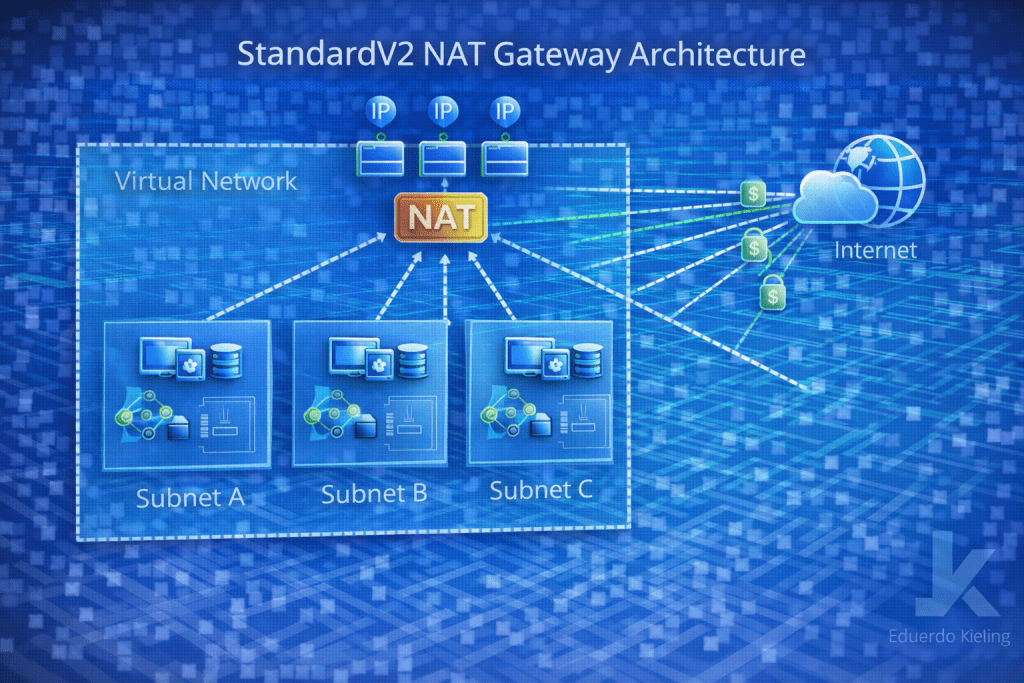
Operationally, this approach creates a predictable outbound connectivity model. Administrators can clearly define which public IPs are used for outbound communication and configure external services to allow traffic from those addresses.
Zone redundancy considerations
High availability is an important design factor in modern Azure environments. Zone redundancy allows infrastructure components to continue operating even if one availability zone experiences disruption.
StandardV2 NAT Gateway supports architectures that align with zone-resilient networking designs.

When workloads are deployed across multiple availability zones, the NAT Gateway architecture can be aligned with the same resiliency strategy, ensuring consistent outbound connectivity even during partial infrastructure failures.
Operational benefits
From an operational perspective, using NAT Gateway for outbound connectivity simplifies several aspects of infrastructure management.
First, it centralizes outbound IP management. Instead of tracking individual public IPs attached to resources, administrators manage a defined set of IP addresses associated with the NAT Gateway.
Second, it improves scalability. NAT Gateway is designed to handle large volumes of concurrent connections, which is important for high-scale workloads such as container platforms or microservices-based applications.
Finally, it integrates cleanly with existing Azure networking constructs such as virtual networks, route tables, and security architectures.
Typical scenarios
The StandardV2 NAT Gateway is particularly useful in several scenarios.
Large application platforms often rely on centralized outbound connectivity for logging systems, update repositories, or external APIs. In these cases, predictable outbound IP addresses simplify integration with external services.
Another common scenario involves container platforms such as Kubernetes clusters, where many nodes generate outbound traffic simultaneously.
Finally, environments with strict security policies often prefer NAT-based outbound access rather than exposing public IP addresses directly on compute resources.
Final thoughts
The StandardV2 NAT Gateway strengthens Azure’s outbound networking capabilities and provides additional flexibility for high-availability architectures.
For organizations operating large or distributed workloads, adopting a centralized NAT strategy helps create predictable, scalable, and resilient outbound connectivity patterns within Azure environments.