Azure Site Recovery Now Supports Premium SSD v2: Resilience Meets Performance

Hello Azure Community,

If you’re running critical workloads on Premium SSD v2 disks, there’s good news: Azure Site Recovery (ASR) now supports disaster recovery for VMs using Premium SSD v2, available in public preview.

This is a key step forward for those of us designing high-performance environments that still require robust business continuity strategies. You no longer need to compromise between performance and resilience — now you can have both.

Continue reading “Azure Site Recovery Now Supports Premium SSD v2: Resilience Meets Performance”

Architecture considerations for Azure Quota Groups

As Azure environments grow, one of the less visible but critical challenges organizations face is controlling how compute resources are consumed across teams. Without proper governance, it is easy for subscriptions to hit limits unexpectedly or for certain workloads to consume more capacity than intended.

Azure Quota Groups introduce a structured way to manage and distribute quota across different workloads, teams, or environments. Instead of treating quotas as isolated limits per subscription, organizations can start thinking about quota management as part of a broader governance model.

Continue reading “Architecture considerations for Azure Quota Groups”

Azure Migrate Adds Support for Ultra SSD: High-Performance Migration Just Got Better

Hello Azure Community,

Another solid improvement is now in public preview — and it’s one that’ll make a real difference for anyone migrating I/O-intensive workloads to Azure: Azure Migrate now supports Ultra SSD as a destination disk type.

For those managing high-performance applications — think SAP HANASQL ServerOracle, or any workload with aggressive latency and throughput requirements — this update gives you the flexibility to bring that performance profile into Azure during migration, right from the start.

Continue reading “Azure Migrate Adds Support for Ultra SSD: High-Performance Migration Just Got Better”

Live Resize for Azure Premium SSD v2 and Ultra Disks: Flexibility Without Downtime

Hello Azure Community,

There’s a new capability in public preview that I believe many of you will find both practical and cost-efficient: Live Resize for Premium SSD v2 and Ultra NVMe Disks.

If you’ve ever had to scale storage mid-deployment — or worse, plan for peak storage needs months in advance “just in case” — this is a feature that changes the game. You can now dynamically expand disk capacity with zero downtimefor your applications.

Continue reading “Live Resize for Azure Premium SSD v2 and Ultra Disks: Flexibility Without Downtime”

Implementing DNAT on Azure Firewall private IP address

Azure Firewall continues to evolve with capabilities that simplify the design of secure network architectures in Azure. One feature that has recently become generally available is the ability to configure Destination Network Address Translation (DNAT) using the firewall’s private IP address.

This capability may seem like a small enhancement at first glance, but it opens new architectural possibilities. In many enterprise environments, traffic flows do not always originate from the public internet. Instead, connections may come from internal networks, private connectivity environments, or hybrid infrastructures.

Supporting DNAT directly on the private IP address of Azure Firewall helps address these scenarios in a more flexible way.

Continue reading “Implementing DNAT on Azure Firewall private IP address”

Understanding Azure Private Subnet behavior and use cases

Hi everyone,

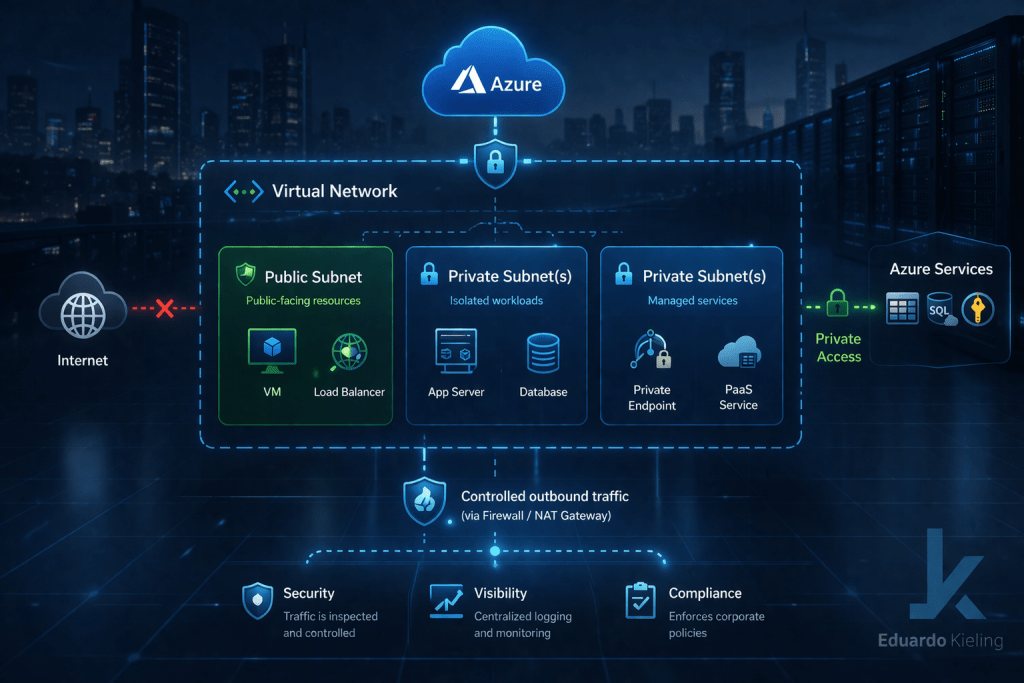
One of the topics that keeps coming up in conversations around secure Azure architectures is how to properly isolate workloads while still keeping connectivity manageable. A feature that plays an important role in this space is the concept of Private Subnets in Azure.

At first glance, it may seem like just another networking configuration, but when used correctly, private subnets can significantly improve how environments are segmented and secured.

Continue reading “Understanding Azure Private Subnet behavior and use cases”

New VM Network Troubleshooter in Azure Portal: Faster Diagnostics, Less Guesswork

Hello Azure Community,

I wanted to share a useful enhancement now available in public preview — especially for those of us who spend way too much time digging into VM connectivity issues. Microsoft has introduced a VM Network Troubleshooter directly in the Azure Portal.

This update brings a lightweight but effective diagnostic tool to the VM Overview blade, helping us quickly identify blocked network ports. It’s a great improvement that makes those “why can’t I connect to my VM?” moments far less frustrating.

Continue reading “New VM Network Troubleshooter in Azure Portal: Faster Diagnostics, Less Guesswork”

Azure Traffic Manager Now Offers 100% SLA for Global DNS Resolution

Hello Azure Community,

I wanted to share a quick update that may seem small at first glance but actually carries significant weight when it comes to availability and trust in your global applications. Azure Traffic Manager has officially raised its SLA for DNS resolution to 100%. Yes, you read that right — 100% SLA for all global DNS queries.

As someone who works closely with clients running multi-region or latency-sensitive applications, I can’t overstate how important this is. DNS resolution is a foundational layer, and knowing it’s now backed by a full SLA gives us a stronger guarantee of reliability — without any action required on our part.

Continue reading “Azure Traffic Manager Now Offers 100% SLA for Global DNS Resolution”