
Hello everyone,
Over the last months Microsoft has been introducing several improvements around large-scale infrastructure management in Azure. One capability that caught my attention recently is Azure Compute Fleet, which aims to simplify the orchestration of large groups of compute resources.
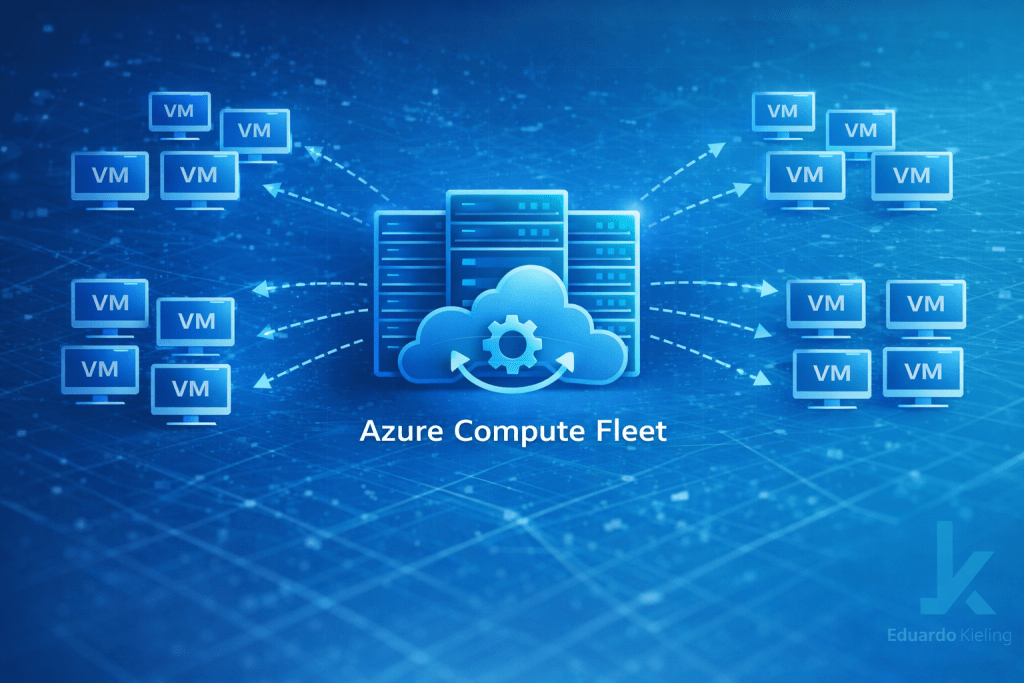
Managing many virtual machines individually can become complex as environments grow. Azure Compute Fleet introduces a way to treat multiple compute resources as a coordinated group, making it easier to deploy, scale, and operate workloads that require large amounts of compute capacity.
What is Azure Compute Fleet
Azure Compute Fleet is designed to coordinate the deployment and lifecycle management of multiple virtual machines in a more unified way. Instead of provisioning and managing instances independently, the platform allows organizations to define fleets of compute capacity that can be controlled as a group.
This model can be particularly useful for environments that rely on large-scale compute resources such as batch processing platforms, large analytics workloads, simulation environments, or high-performance computing scenarios.
By treating infrastructure as a coordinated fleet rather than individual machines, operations teams can simplify deployment patterns and reduce the operational overhead of managing large compute environments.
Potential use cases
Several scenarios can benefit from this capability.
Organizations running compute-heavy workloads often need to scale infrastructure quickly based on demand. With Compute Fleet, infrastructure can be orchestrated more efficiently to support dynamic workloads such as data processing pipelines, machine learning training jobs, or distributed simulations.
Another common use case is environments where large numbers of compute instances must be created and destroyed frequently. Batch workloads or scheduled compute jobs can benefit from a model where infrastructure is managed collectively instead of individually.
Operational considerations
From an operational perspective, Compute Fleet can help standardize how compute capacity is deployed and maintained. When infrastructure is managed as a fleet, configuration patterns become more predictable and easier to automate.
However, organizations should still consider aspects such as regional capacity, VM sizing strategies, and cost optimization when designing fleets of compute resources.
Combining this capability with infrastructure-as-code approaches and automation pipelines can further simplify the management of large compute environments.
Initial thoughts
Azure Compute Fleet represents an interesting step toward simplifying large-scale compute orchestration in Azure. As cloud environments continue to grow, tools that allow infrastructure to be managed collectively rather than individually can significantly reduce operational complexity.
I will continue exploring this capability in more detail and observing how it evolves as more organizations start adopting it in real-world workloads.
If you are managing environments that require large-scale compute resources, this is definitely a feature worth keeping an eye on.