
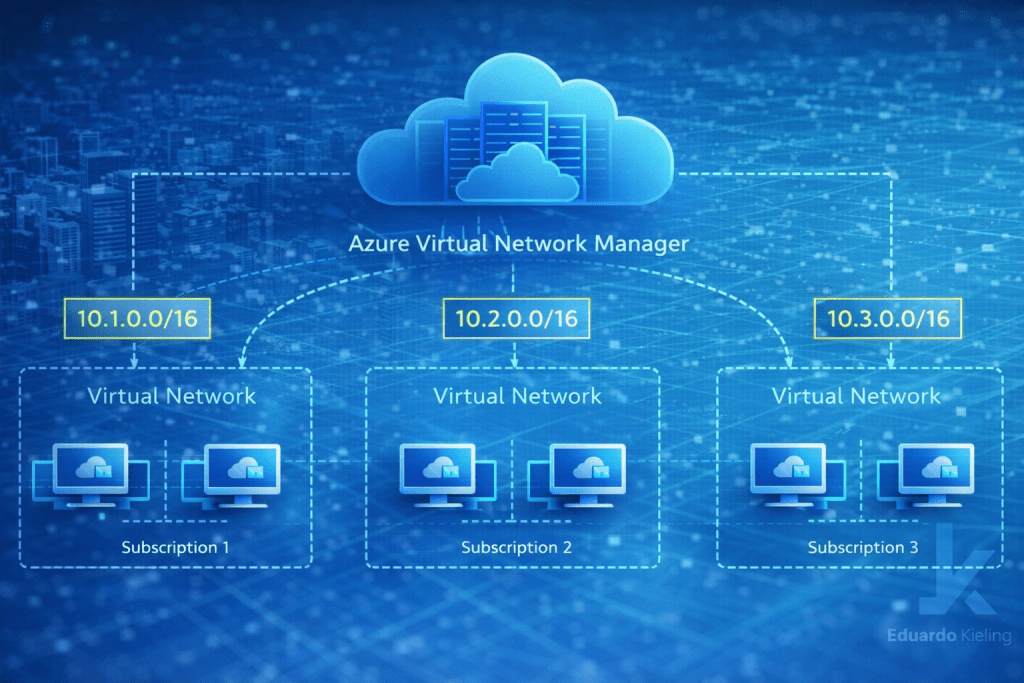
As Azure environments grow, managing IP address space becomes increasingly important. What starts as a small set of virtual networks can quickly evolve into dozens or even hundreds of interconnected networks supporting multiple applications, environments, and regions.
Without proper planning and governance, IP addressing can become fragmented, overlapping, and difficult to maintain. This is where Azure Virtual Network Manager introduces valuable capabilities that help organizations manage networking at scale.
One of the key areas where this service can bring operational improvements is IP address management and network planning across large Azure environments.
The challenge of IP address management in cloud environments
Traditional data centers often relied on centralized IP address management systems and strict network planning processes. In the cloud, however, the speed of infrastructure deployment can make it easy for address planning to become inconsistent.
Development teams may create new virtual networks frequently, infrastructure automation may deploy resources dynamically, and multiple environments may evolve independently across subscriptions or regions.
Over time, this can result in overlapping address spaces, routing conflicts, or complex connectivity limitations when networks need to be connected through peering, VPN gateways, or ExpressRoute circuits.
Address management therefore becomes a critical part of maintaining scalable cloud network architectures.
The role of Azure Virtual Network Manager
Azure Virtual Network Manager was designed to simplify the management of networking resources across large Azure environments. Instead of managing networks individually, administrators can define policies and configurations that apply consistently across multiple virtual networks.
From an IP management perspective, the service helps organizations maintain visibility and governance over network address allocations.
When deployed as part of an enterprise architecture, Virtual Network Manager can act as a central control point for defining connectivity models, network segmentation strategies, and address planning guidelines.

This centralized approach becomes particularly valuable in large organizations where multiple teams operate different environments but must still adhere to common networking standards.
Designing address space for scalable architectures
Effective IP address planning should always anticipate future growth. Instead of allocating address ranges only for immediate workloads, architects should design address spaces that support expansion across additional virtual networks, regions, or environments.
A structured addressing model can simplify routing, connectivity, and troubleshooting.
For example, organizations often segment address spaces by environment or functional area. Production workloads may use dedicated ranges, while development or testing environments use separate segments. Regional expansion can also be accommodated through reserved address blocks.
Azure Virtual Network Manager supports this type of governance by providing visibility and centralized configuration capabilities that align with these planning strategies.
Integration with enterprise network architectures
In enterprise landing zone architectures, virtual networks are commonly organized using hub-and-spoke models. The hub network hosts shared services such as firewalls, gateways, and monitoring systems, while spoke networks host application workloads.
In these environments, IP address planning must be coordinated carefully so that all networks can communicate reliably without conflicts.
Azure Virtual Network Manager can help enforce connectivity rules and maintain consistent network structures across large environments.
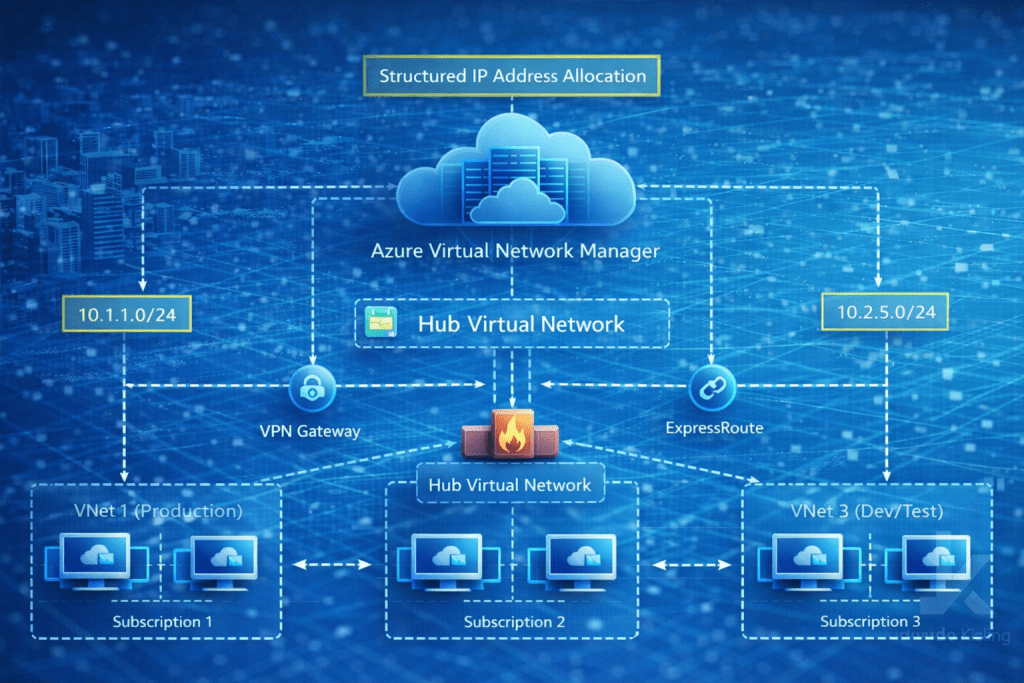
This centralized governance model reduces the risk of address overlap and helps maintain predictable network behavior as environments grow.
Operational benefits
Beyond architecture design, centralized IP address management also provides operational advantages. Network teams gain improved visibility into how address spaces are being used across the environment.
This can simplify troubleshooting scenarios, accelerate onboarding of new workloads, and support more consistent automation pipelines.
Infrastructure teams can also establish standards that guide how networks are created and connected, ensuring that future deployments remain aligned with the organization’s network strategy.
Final thoughts
Managing IP address space may not always receive the same attention as other aspects of cloud architecture, but it plays a critical role in maintaining scalable and reliable environments.
Azure Virtual Network Manager introduces capabilities that help organizations maintain structure and governance as their Azure networking environments expand.
For teams operating large cloud environments, adopting centralized approaches to network governance and address planning can significantly simplify long-term infrastructure management.