
As Azure environments grow, one of the less visible but critical challenges organizations face is controlling how compute resources are consumed across teams. Without proper governance, it is easy for subscriptions to hit limits unexpectedly or for certain workloads to consume more capacity than intended.
Azure Quota Groups introduce a structured way to manage and distribute quota across different workloads, teams, or environments. Instead of treating quotas as isolated limits per subscription, organizations can start thinking about quota management as part of a broader governance model.
Understanding quota management in Azure
Azure quotas define the maximum amount of resources that can be deployed within a subscription, such as the number of virtual machines, cores, or other compute-related limits. Traditionally, these limits are managed at the subscription level, which can create challenges in larger environments.
In organizations with multiple teams sharing subscriptions or operating across several environments, quota management becomes more complex. Teams may compete for the same capacity, and unexpected consumption can impact critical workloads.
Quota Groups address this by allowing organizations to logically group and control how quota is allocated and consumed.
Where quota groups fit in architecture design
From an architectural perspective, Quota Groups become particularly relevant in environments that follow structured governance models such as Azure Landing Zones.
In these environments, subscriptions are typically aligned to specific purposes such as production, development, or shared services. Within each subscription, multiple teams or workloads may coexist, each with different compute requirements.

Quota Groups allow architects to define boundaries inside these environments, ensuring that each workload or team operates within a controlled allocation of resources. This reduces the risk of resource contention and improves predictability.
Governance and control scenarios
One of the main benefits of Quota Groups is the ability to enforce governance at a more granular level. Instead of relying only on subscription-level limits, organizations can define how compute capacity is distributed across internal consumers.
This is particularly useful in scenarios where multiple business units share the same Azure environment. Each unit can be assigned a portion of the available quota, ensuring fair usage and preventing a single workload from exhausting shared resources.
Quota Groups can also support cost management strategies by indirectly controlling how much infrastructure can be deployed by each team.
Operational considerations
While Quota Groups provide additional control, they also introduce the need for planning and monitoring. Architects and operations teams should define clear allocation strategies based on workload requirements and expected growth.
Monitoring usage against assigned quotas becomes important to avoid situations where teams are constrained unexpectedly. Proper visibility into consumption helps teams request adjustments proactively instead of reacting to limits being reached.
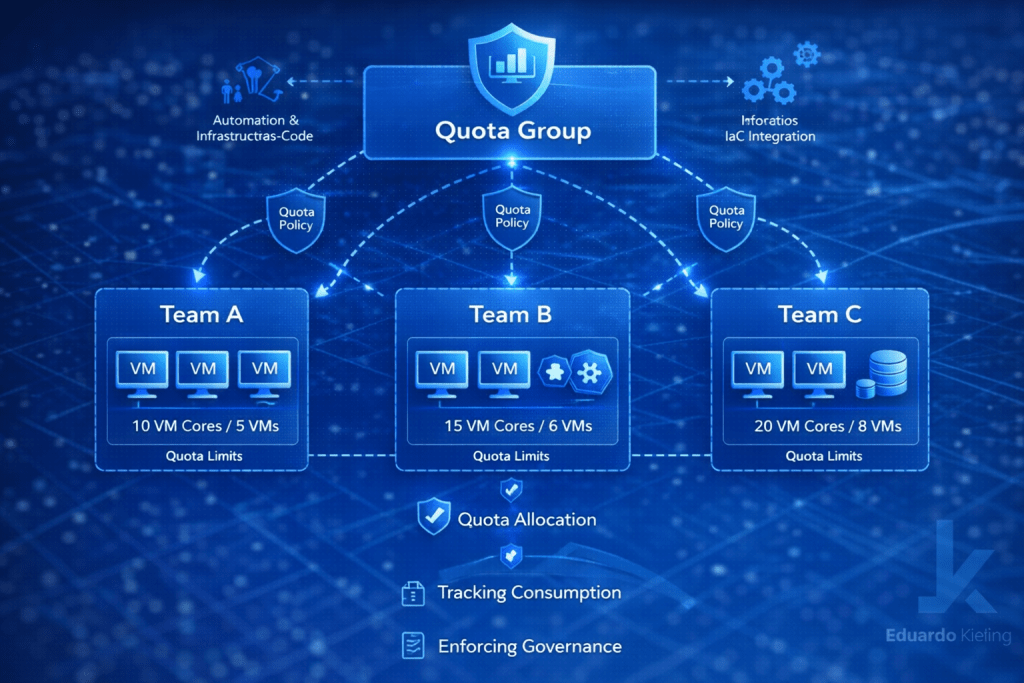
Integration with automation and infrastructure-as-code can further enhance how Quota Groups are managed, ensuring that environments remain consistent and aligned with governance policies.
Practical use cases
Quota Groups are especially valuable in large-scale environments where many workloads are deployed dynamically. Examples include platform teams supporting multiple application teams, environments with heavy use of automation pipelines, or organizations running compute-intensive workloads.
They also help in environments where capacity planning is critical, such as high-performance computing or large-scale batch processing systems.
Final thoughts
Azure Quota Groups introduce a more structured way to manage compute resource consumption across complex environments. By enabling controlled allocation of quota, they help organizations improve governance, avoid resource contention, and maintain better visibility over infrastructure usage.
As Azure environments continue to scale, capabilities like this become increasingly important to ensure that growth remains controlled and aligned with organizational policies.